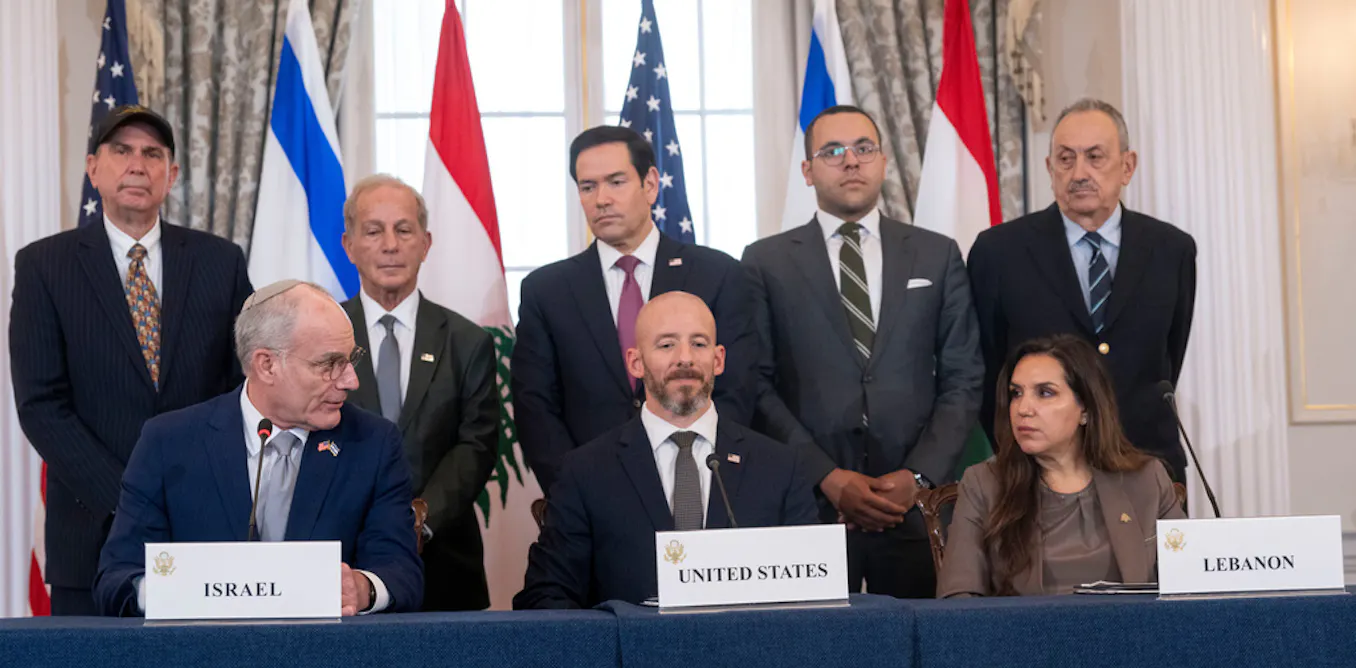
If implemented, the framework agreement hammered out between Lebanon and Israel in June 2026 could serve as the most consequential agreement between the two countries in nearly 80 years.
But that is a big “if.” The deal envisions peaceful relations between the two states and lays out a road map to disarm the Shiite militant group Hezbollah, secure Israel’s full withdrawal from Lebanon and restore Lebanese sovereignty over its entire national territory.
As it stands now, all of those provisions are a far cry from reality. For one, Hezbollah has rejected the agreement outright. Meanwhile, Israel’s continued military operations risk undermining the domestic legitimacy of the Lebanese government and, ultimately, its ability to implement the agreement.
As experts on armed conflict, ceasefires and peace processes in the Middle East, we have studied past ceasefires between Israel and Hezbollah in 1993, 1996, 2006, 2024 and April 2026. Our forthcoming paper on the subject demonstrates a consistent pattern: Each agreement created only a temporary interval before hostilities recurred or only marginally reduced violence. Throughout, there appeared to be a tacit understanding between Hezbollah and Israel that conflict would eventually resume.
Lebanon and Israel have never normalized relations, but they do have a precedent for an agreement that successfully contained conflict. The 1949 U.N.-brokered Lebanese-Israeli General Armistice Agreement ended hostilities following the 1948 Arab-Israeli war. With sustained international backing and U.N. monitoring, it established the de facto border that largely remains in place today and prevented a return to full-scale war for roughly two decades.
That relative stability began to unravel in the 1970s as the Palestine Liberation Organization expanded its armed presence in Lebanon, provoking repeated clashes with Israel that culminated in Israel’s invasions of Lebanon in 1978 and 1982.
Since Israel’s 1982 full-scale invasion of Lebanon, agreements and ceasefires intended to end hostilities have repeatedly broken down. Parties have exploited lulls in fighting to buy time, rebuild capabilities and consolidate political or territorial gains ahead of the next round of conflict.
The 1983 agreement between Israel and Lebanon offers both an example of this dynamic and an enduring lesson. It promised peace and normalization in exchange for an Israeli withdrawal from Lebanon. But it unraveled within a year when anti-government forces launched a joint offensive against Lebanese army positions in West Beirut, shattering the authority of the Lebanese government and fracturing the army along sectarian and ideological lines. The 1983 agreement thus failed because the Lebanese state had lost its ability to implement it.
Israel became mired in a prolonged occupation. In that environment, Hezbollah emerged from a network of Shiite Islamist militants, making its dramatic entry into the war by attacking an Israel military base in 1982. It later carried out the bombings of the U.S. Embassy in Beirut and the barracks of American Marines and French peacekeepers in 1983.
In the decades that followed, Hezbollah grew in power, leveraging sustained Iranian support and the potent narrative of resistance to Israel. Since then, conflict in Lebanon has largely revolved around the struggle between Hezbollah and Israel.
Violence flared and subsided periodically, and Lebanon and Israel reached ceasefire agreements in 1993, 1996 and after a 2006 war. Crucially, however, Hezbollah’s disarmament was either left off the agenda – as in the 1993 and 1996 ceasefires – or incorporated into a 2006 U.N. Security Council resolution that failed to lay out credible mechanisms for implementation.
As such, the periods of relative calm that followed these ceasefires created space for Hezbollah to rebuild its military capabilities, consolidate its political influence and retain the initiative over when to resume hostilities with Israel.
The present-day context is in many ways unique because the balance of power in Lebanon has shifted in ways that make Hezbollah’s disarmament – and a historic Lebanese settlement with Israel – more politically plausible than at any point in decades.
Israel’s military campaigns have significantly degraded Hezbollah, while public opinion in Lebanon has increasingly turned against the group, blaming it for repeatedly dragging the country into unnecessary wars.
Even among Lebanon’s Shiite community, support for Hezbollah is weaker than in the past, and anger toward Iran, its main sponsor, is growing.
Since coming to power in 2025, Lebanon’s President Joseph Aoun and Prime Minister Nawaf Salam have sought to capitalize on this shift by pursuing Hezbollah’s disarmament in line with the 2006 U.N. resolution, which calls for the disarmament of all nonstate armed groups in Lebanon and the extension of Lebanese state authority to the south.
For years, these provisions remained largely aspirational. Today, they are a concrete possibility.
But the window for diplomacy remains narrow, and actions by both Israel and Hezbollah risk closing it. The danger is that short-term political incentives override longer-term strategic opportunities.
With elections approaching and few of the stated objectives of Israel’s war with Iran having been achieved, Prime Minister Benjamin Netanyahu is under mounting pressure to demonstrate tangible results against Hezbollah.
As such, prolonging the conflict in Lebanon may offer domestic political advantages – delaying proceedings in his criminal trial and allowing him to campaign as a wartime leader with strong security credentials.
Hezbollah, meanwhile, is attempting to capitalize politically on Israel’s continued military operations and Netanyahu’s insistence on maintaining a long-term presence on Lebanese soil.
For an organization built on resistance to Israeli occupation, reclaiming that mantle may offer the most effective path to renewed relevance and legitimacy.
In a paradox that borders on the tragic, Israel may find itself repeating the strategic mistakes that helped create Hezbollah in the first place and giving new life to an adversary it has brought to the brink.
The broad pattern of four decades of conflict and ceasefire negotiations indicates that Hezbollah and Israel remain committed to continued confrontation. As such, the likelihood that the ceasefire will give way to full-scale war remains high, in our opinion. That is, unless ongoing, face-to-face diplomacy is strengthened and professionalized.
Expert diplomacy has often been indispensable to major breakthroughs in conflict resolution. During the 1973 Arab-Israeli war, Egyptian and Israeli commanders met face to face along the Suez–Cairo road, under U.N. auspices. Both sides had an interest in halting the fighting and broadly agreed on the principles that eventually led to disengagement and, ultimately, the Egyptian-Israeli peace treaty of 1979.
More recently, American diplomacy demonstrated that even long-standing disputes between Israel and Lebanon are not beyond negotiation. After brokering the 2022 maritime boundary agreement, U.S. envoy Amos Hochstein launched a new round of talks aimed at resolving disputed sections of the land border and reducing tensions along the Blue Line – a U.N.-determined demarcation line pending the negotiation of the final border. Those efforts were overtaken by the Oct. 7, 2023, attacks by Hamas and the regional wars that followed, but they demonstrate that sustained U.S. engagement can produce tangible progress.
It is clear that sustained diplomacy is necessary for the success of any agreement. In the present context, that would require American pressure on Israel to curtail military operations on Lebanese territory. Moreover, the next stage of negotiations will have to confront more long-standing territorial and political disputes that have bedeviled regional peace.
At the same time, Lebanon will require steady diplomatic backing to maintain momentum on Hezbollah’s disarmament, alongside security assistance and financial support to enable the Lebanese military to extend government authority over the entire national territory.
Moments like this are rare in armed conflict. They arise not from design but from the unintended convergence of military outcomes, political shifts and diplomatic initiative. They are also fleeting.
The history of the Israel–Lebanon conflict is littered with missed opportunities and openings that closed before they could be consolidated. This may be one of them. It has the contours of a breakthrough – and the fragility of a mirage.